5. Transparent and honest rectification policy
Transparency
We are transparent when the verdict of a claim is changed for various reasons, such as the emergence of a larger or more recent official data set, the publication of a better answer, etc.
Here's how we ensure that we have a transparent rectification policy:
-
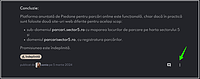
we publish (in reverse chronological order) all editing actions of a response (the text of a check); to view this history, navigate to the page of a claim, to the "Response(s)" section, look for the "3 vertical dots" menu located at the end of the response (bottom right), click on this menu and select the "show versions" option, then you will be redirected to the "Response history" page (an example here):
-
if a contributor publishes a response to a statement and then changes his mind about the verdict for that statement, and the new verdict will be very different from the first verdict given, then he must publish a second response to that statement, so that readers can compare the arguments that led to the first verdict with the arguments that led to the second verdict (an example here);
-
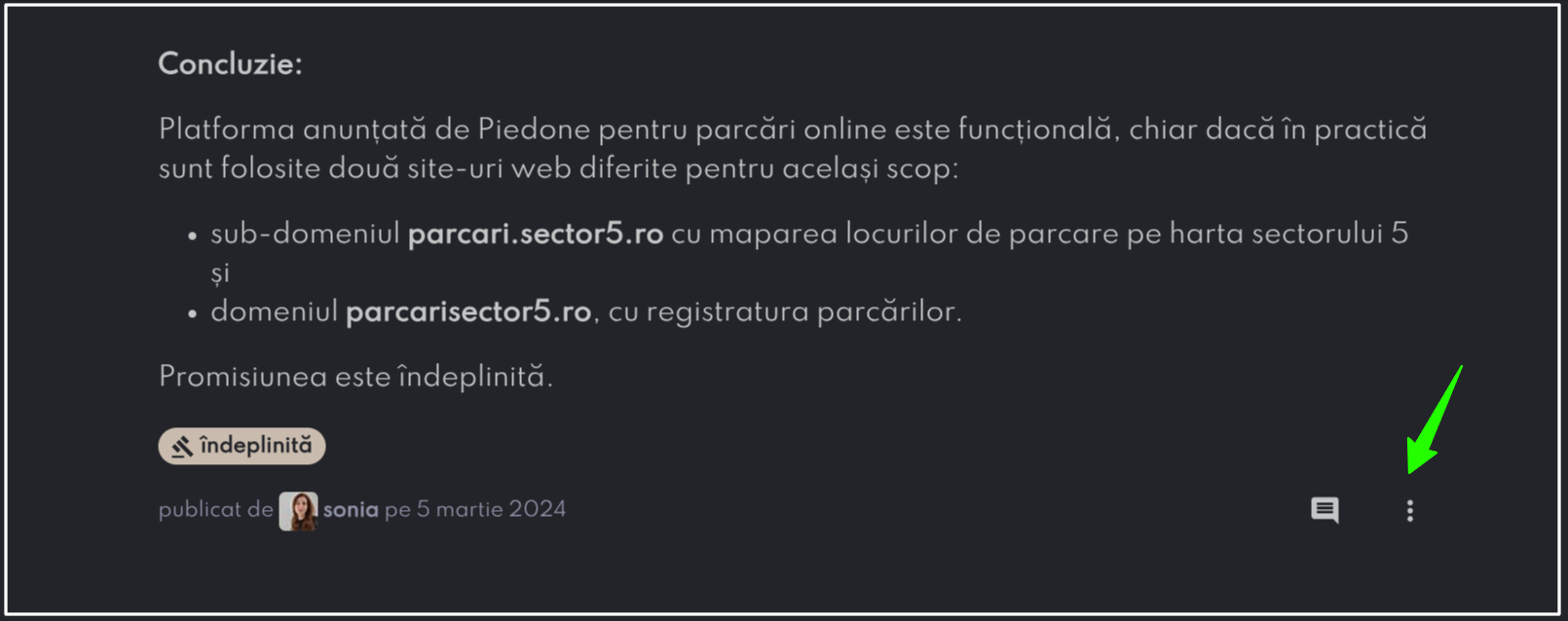
if a contributor publishes a response to a statement and then changes his mind about the verdict for that statement, and the new verdict will be very similar to the first verdict given, then he can edit the given response (without publishing another response), but must mark the added text in the response with the header "Updated on ..." (or with another equivalent wording); an example here.
Honesty
We are honest when a statement cannot be verified at all, or cannot be verified at the moment due to a lack of official data. Such statements receive the verdict "undecidable", see an example here.
You can view all statements on Dignitas that have a verdict "undecidable" if you navigate to the main page, the "Recent statements" section, click on the "other filters" button and select the "verdict" option in the "decidable" filter.
Corrections, right to reply
If you notice a mistake/error in the statements/answers/politicians' profiles published on Dignitas, please contact us. We will publish a list of corrected mistakes when we receive such reports.
If you believe that you can contribute a better/more correct response to a particular statement verified on Dignitas, you can publish your own response to that statement (you need a user account created on Dignitas). The added response must meet the Dignitas criteria mentioned here, otherwise the response may be deleted.
If you are the subject of a fact-checking by us and wish to exercise your right of reply, please use the contact details. A Dignitas moderator will read your message and decide whether changes are necessary to the content published by us, according to our errata policy detailed below.
Errata Policy
Our Errata Policy is intended to publicly explain the procedure that the Dignitas editorial team must follow if they discover an error after publishing a fact-check (i.e. an accepted answer as proof for a fact-checked claim); thus, we avoid promoting false, incomplete, incorrect or distorted information.
Dignitas Errata Policy:
P1. By "error" we mean any information that is completely/partially false, wrong, misleading, and any purely technical or editorial mistake (not related to the contributor's reasoning).
P2. By "minor error" we mean an error that will not influence the conclusion of a fact-check (i.e. the verdict chosen for the claim we analyzed).
P3. By "major error" we mean an error that will most likely influence the conclusion of a fact-check.
P4. Corrections should be made quickly and publicly, so that readers can see and understand them.
P5. For major errors in the text of the "Context" or "To Check" sections of the description of an already checked statement, the correction (errata) should:
- be added immediately after the paragraph containing the error and be marked with the text "Updated on ..." (the date it was added); the text of the error should be preserved so that the responses already published (for that statement) do not lose their meaning (i.e. the dates they started from);
- explain why it was created.
P6. For major errors in the text of the "Context" or "To be verified" sections of the description of an not yet verified statement, the statement in question will be deleted or closed, as appropriate.
P7. For major errors in the text of an answer (i.e. in the verification/fact-check of a statement analyzed by us), the rectification (errata) must:
- be published as a new answer; the old answer accepted as a demonstration is not deleted, but must be unchecked as "accepted as a demonstration" by a moderator, respectively the old answer can be marked with a negative vote by the contributor adding the errata;
- contain a new Conclusion (verdict), which will dictate the new verdict of the analyzed statement;
- be marked by a moderator as an "accepted as proof" answer, and the statement's verdict must be updated according to the new answer (also by a moderator).
P8. For small errors, such as spelling errors, invalid or incorrect links, etc., the correction (errata) will directly replace the wrong text, and the history of changes made can be tracked using the "show versions" option in the "3 vertical dots" menu.
P9. Corrections on social networks:
- if a statement verified by us was published on social networks, and this statement subsequently underwent a major correction, then we will also publish the correction of the statement in question, on the same social networks used initially;
- if the error appears (also) in a post on social networks, and correcting the error is not possible by editing the post, then we reserve the right to completely delete the post in question;
- if the post to be deleted has gathered comments, likes or shares from readers, then the deletion of the post will be announced in a comment and only then will the post be deleted.